Every international transaction that involves physical goods requires accurate documentation to ensure hitch-free dealings. Also, an exporter can only prove to a buyer that he has sent purchased goods as agreed by providing important document such as Bill of Lading.
Furthermore, if someone is trying to sell merchandise that is still on transit, a bill of lading is possibly the only document with which to convince the buyer. It’s one of the most relevant documents in marine transportation of petroleum products.
What Does Bill of Lading Mean
Bill of lading is a legal document that shows detailed records of goods a shipper wants to ship through a carrier. It is evidence of an agreement between the shipper and the transporter for the transportation of goods. Also, it shows the type of cargo a seller wants to ship to a buyer via a carrier.
It usually originates from a carrier to a shipper stating goods’ shipping condition as well as POD. Furthermore, it contains information about the transporter, consignor and consignee. Your CIF transaction is incomplete without a bill of lading.
Importance of BoL
Bill of lading serves as evidence of an agreement, evidence of ownership and proof of the certainty of shipment. Just as commercial invoice binds both consignee and consignor, a BoL is a contract binding both carrier and consignor. Let us now take a look at the importance of B/L in importation/exportation of goods.
Evidence of Agreement Between Shipper and Transporter: It serves as evidence that a shipper and a transporter have entered into a contract of carriage. In other words, it is a piece of documentary evidence that a carrier has agreed to transport a consignment on behalf of a shipper.
Proof of Certainty of Shipment: It serves as proof that a carrier will ship cargo to a named port provided by a shipper. Note that the carrier will not issue a Bill if the consignment is not in his custody.
Evidence of ownership (Document of Title): An importer cannot lay claim to his goods until he provides copies of BL. Therefore, the B/L serves as proof of ownership of a given consignment.
In summary, the document in question serves two contractual purposes – contract of carriage and receipt issued by a carrier to a shipper.
Types of Bill of Lading
There are numerous types of Bill out there, but here are some of the most common ones.
Clean Bill of Lading: This type of bill is signed by the shipping company, stating that the shipper loaded the goods in good condition before being shipped.
Claused BL: This type of BoL is specifically for goods with defects on arrival. It reveals every flaw such as stained prints, broken package, leakages and many more. Additionally, it gives an account of damaged and missing quantities. The essence of issuing a claused bill is to put both consignee and consignor in the know of the state of goods.
Straight BoL: Usually issued to a specified shipper, a straight bill of laden forbids the transfer of title. In other words, it’s a non-negotiable bill of title, and this makes its assignment impossible.
Order Bill of Lading: This is usually a BoL issued in respect of cargo with deferred payment. It is a negotiable instrument hence, could be transferred to a third party. When a shipper issues a bill of lading to the order of a consignee, it’s evidence that the latter has not paid for ordered goods.
Bearer Bill: This type of bill permits delivery of goods to the bill bearer. It’s an open bill that doesn’t specify the receiver, thereby enabling whoever bears the document to receive goods.
Surrender BoL: It is a bill which legally confers ownership on a buyer after effecting payment for goods. One major thing to note is that the custodian bank will not release the document to the buyer until he makes payment.
Other Types of BoL
Inland Bill: This type of bill is usually for domestic use. It is mostly used in road and rail forms of transport. Like every other BoL, it serves as a carriage of the contract document. An inland BoL has limitations reason being that it only covers land transportation. Shippers require additional bill such as Ocean B/L if he intends to ship consignment overseas.
Through Bill of Lading: With a through BoL, a shipper can transport goods through several means of transportation. It’s more or less an all-inclusive Bill of Lading as it comprises inland and ocean bill. The primary consideration for its preference over other types of Bill of Lading is goods’ destination.
Direct BoL: As the name implies, a direct bill becomes the best option when you don’t need to transship cargo from one ship to another. In other words, it’s only applicable where the ship at the point of loading is responsible for taking consignment to the port of discharge.
Combined Transport BoL: When different means of transportation are involved in transferring goods to its final destination, combined transport BoL is issued. The carrier takes total responsibility for all modes of transportation.
Stale Bill: A state BoL has two different uses. First, when goods get to its destination ahead of the BoL, the bill becomes stale.
Received Bill of Lading: Serves only as a receipt for goods accepted for shipment on a named ship. It is just an acknowledgement of receipt of goods by carrier but no evidence of loading.
CONTENTS OF BoL
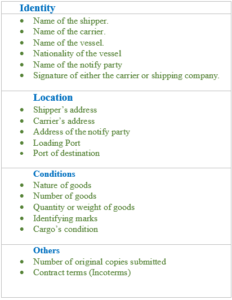
- Identity:
Name of the shipper ∗ Carrier’s name ∗ Vessel’s name ∗ Vessel’s nationality∗ signature of the carrier or shipping company. - Location:
Shippers address ∗ Carrier’s address ∗ Notify Party’s Address ∗ Loading Port ∗ Port of Destintion. - Conditions:
Name of Goods ∗ Number of Goods ∗ Quantity or weight of Goods ∗ Identifying Marks ∗ Cargo’s Condition - Others:
Numbers of Original Copies Submitted ∗ Contract Terms
These are the essential information contained in a Bill of Lading, and these include the name and logo of the shipping line, as well as the Vessel’s name and number. Also, the name of the shipper and his address will be on it as well.
Additional information includes the names of the port of loading as well as the port of discharge. The former is the port where shippers will be shipping the goods from while the latter is the port of destination for the cargo.
Also, container description and the total number of containers and packages would reflect on the Bill of Lading. Other information includes the weight of goods, freight payable as well as a clear description of cargo.
Summary
A bill of lading is a contract of carriage between a carrier and a consignor. Also, it is a document with which a carrier acknowledges receipt of goods for shipment from a consignor. It usually originates from a carrier to a shipper and serves as evidence of an agreement between the duo to transport goods to a named buyer.
Furthermore, we discussed its importance which includes its role as evidence of contract and shipment. Also, we stated that it’s a document with which an importer could lay claim to goods at the destination port. In other words, it’s a document of title.
There are different types of B/L, and each derives its name from the purpose it’s serving.
A clean bill is importer’s delight because it’s an assurance that his goods are in good condition while a claused BoL is its exact opposite. Also, a B/L is a negotiable instrument, and it does allow ownership transfer.